
In the last few weeks I’ve gone back to reviewing submissions as an intern editor at Literary Wanderlust, but also a few word counts on calls for beta readers and this is why, even if you’re self-pub, you need to know why word count matters.
Word counts are very closely tied to the genre they’re in. So forget for a moment about short stories (under 7.5k) or novellas (between 20k and 40k), and lets just look at genre and why the word count expectations have changed in the last few years. (Its gonna be about money, you know it, I know it, lets set the expectation).
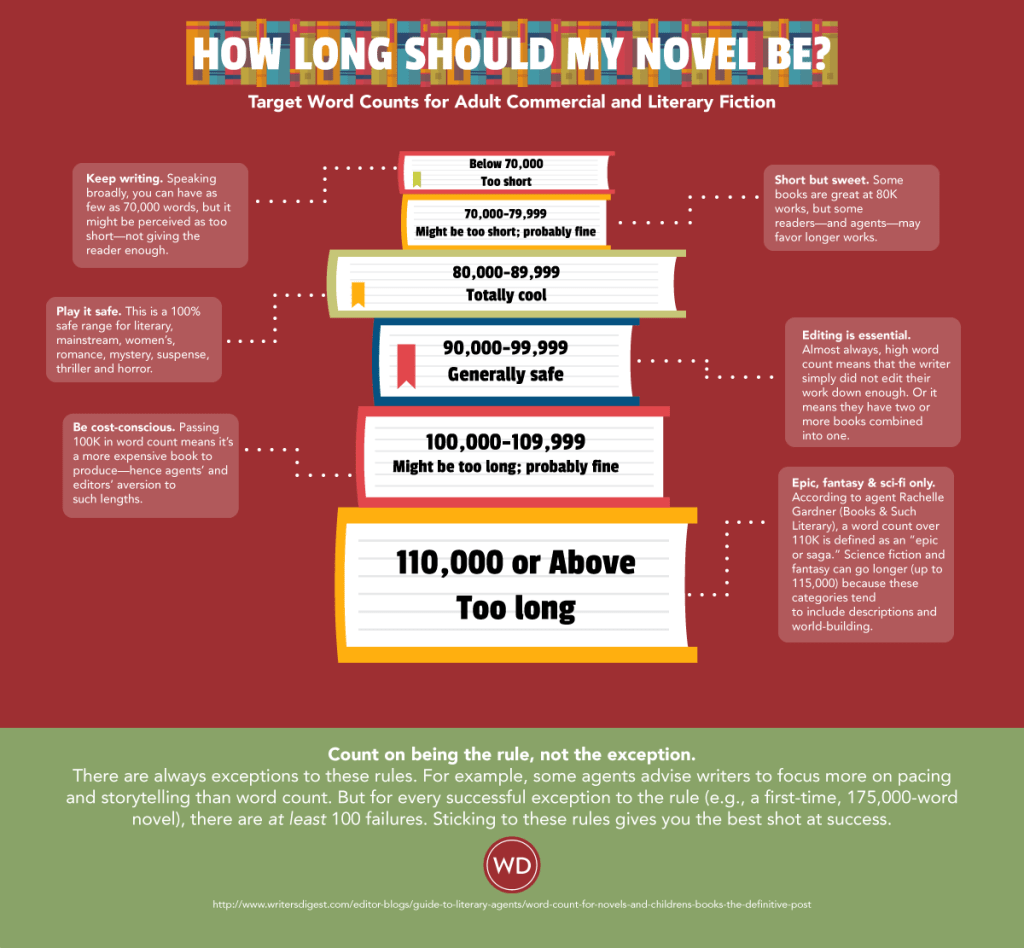
Back in 2016 the Writer’s Digest had this handy little table that I often saw agents refer back to even as late as 2021 when it came to word counts. This was because this was an industry standard.
You know what that also means? It’s a reader standard too. Readers come to expect certain things from the genre too. Because they’re used to buying books in book stores on their favourite subjects and those books met the industry standard and so by default the reader standard. Indie’s and selfpub butt up against this a lot, or throw it to the wind, some with success and others not.
Here is where watching the industry over the last few years has paid off because for all of the monster that Tiktok became of recommending 300k fanfics (Manacled, I’m looking at you), the expectation on word counts hasn’t grown but gotten smaller.
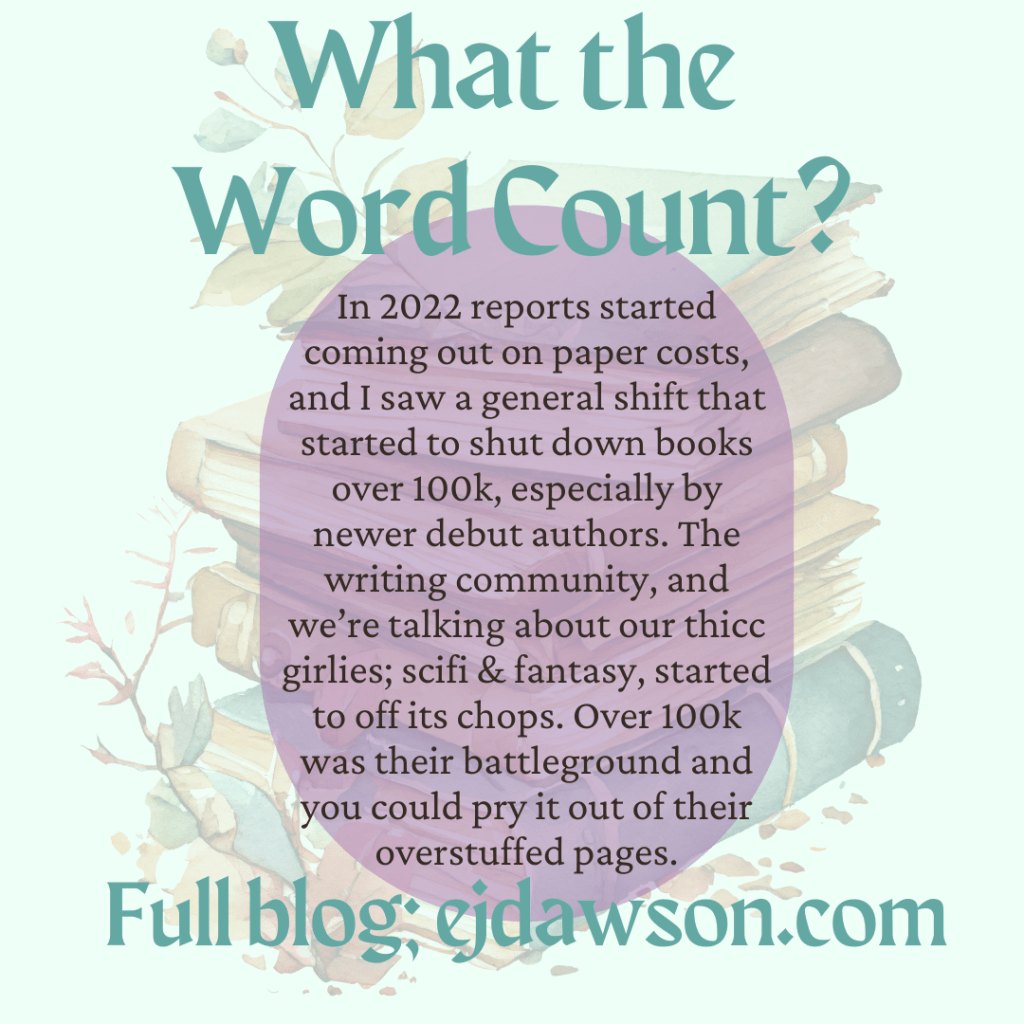
In 2022 reports started coming out on paper costs, and I saw a general shift that started to shut down books over 100k, especially by newer debut authors. The writing community, and we’re talking about our thicc girlies; scifi & fantasy, started to off its chops. Over 100k was their battleground and you could pry it out of their overstuffed pages.
But it wasn’t about the book’s content and whether it was necessary, it wasn’t about costly editing to projects over 100k. It was about the paper.
Brexit, the post covid market, it’s been labelled down to a lot of things, many of the articles hidden behind paywalls your author can’t afford this month (please buy my books). Ultimately it did depend a lot on your local economy, but it didn’t change that the cost of paper had gone up, and therefore the cost to print books. Agents started to be more curtailed in their wish lists, some specifying that for unpublished authors they didn’t want manuscripts over 100k.
“But there are so many books with over 100k word totals!”
Yes, yes, sit down, be quiet.
Many of these, and I’m looking at Priory of the Orange Tree which is a monster of a book at 225k and I’m still very sad that the mixing story lines couldn’t hold my attention long enough to finish that, are not from debut authors. Because the next thing most budding authors will come back and refer to Shannon’s debut book the Bone Season that came out to 130k words.
In 2012.
Publishing was a vastly different place and I like to think of it as a marshy forestland full of fog and mystery. The point is that the market has changed rapidly with the rise of self-publishing and the ability for those books to now be successful. Which is a whole other topic so back to word counts we go.
In a much more up to date version of word counts Reedsy has come out with this little table;

What is interesting about this is that it takes into consideration what the “industry standards” are, but acknowledges books are currently falling far under that word count – but I digress.
The handy article talks about how 120k word manuscripts aren’t commonly seen anymore, especially from new authors. Much of that is down to the cost and sellability of an unknown author.
This is why authors with a ten year back ground in publishing can keep publishing 100k books and no one cares, but if you are newer then the advice across the board is stick to under 100k.
A lot of that can also be about a newer author learning how pacing works, having too many unnecessary words or scenes, or even whole arcs. There is quite a lot of stuff you can put into a first draft that isn’t essential to a plot and will probably be next week’s topic on why I write a whole ass draft before the real novel now.
The article from Reedsy is actually reflecting the word counts they see on their platform in those genres, which is far more in line with my expectations of word counts for novels these days. With more people publishing and more authors needing to market their book to be heard over the million books a year publication rate on Amazon, giving shorter reads is becoming the norm.
This allows for a rise I feel in series which is wonderful because everyone likes to spend more time with their favourite characters, but that isn’t always the case, and sometimes doesn’t do a story justice.
Can your book be over 100k? Absolutely. Should it? That’s really about how you want your publishing story to go, and if its trad whether agents will be engaged enough to take on a project that big.
On a personal note, I do not like nor accept novels over 100k for a very simple reason; it’s a lot of work and I don’t always see a reason within the text itself for many stories to be that long. There are exceptions, I have my own novels over 100k, and will continue to self-publish those. But that is a personal choice.
Remember, there are a lot of factors to an authors success, 100k word count or not, and some rules are made to be broken.


 E. J. Dawson
Leave a comment